Table Of Content

Whether the reader is trapped by the house or by its inhabitants is unclear. Poe uses the term house to describe both the physical structure and the family. On the one hand, the house itself appears to be actually sentient, just as Roderick claims. Its windows are described as “eye-like,” and its interior is compared to a living body. On the other hand, there are plenty of strange things about the Usher family. For one, “the entire family lay in the direct line of descent,” meaning that only one son from each generation survived and reproduced.
Episode 2, "The Masque of the Red Death"
A series of bizarre incidents and exotic discoveries at sea, Pym lacks the cohesive elements of plot or quest that tie together most novels and epics and is widely considered an artistic failure. Poe’s style and concerns never found their best expression in longer forms, but his short stories are considered masterpieces worldwide. After leaving the University of Virginia, Poe spent some time in the military before he used his contacts in Richmond and Baltimore to enter the magazine industry. With little experience, Poe relied on his characteristic bravado to convince Thomas Willis White, then head of the fledgling Southern Literary Messenger, to take him on as an editor in 1835. Poe ultimately fell out of favor with White, but his literary criticism made him a popular speaker on the lecture circuit. Poe never realized his most ambitious dream—the launch of his own magazine, the Stylus.
Is The Fall of the House of Usher based on a true story?
He describes a childhood friendship with the owner, Roderick Usher.Roderick had requested the narrator’s company during his convalescence from anillness. The narrator reflects on the once-great Usher family and that theyhave only one surviving direct line of descendants, comparing the beautiful butcrumbling house to the family living inside. Fearing that her body will be exhumed for medical study, Roderick insists that she be entombed for two weeks in the family tomb located in the house before being permanently buried. The narrator helps Roderick put Madeline's body in the tomb, whereupon the narrator realizes that Madeline and Roderick are twins. The narrator also notes that Madeline's body has rosy cheeks, which sometimes happens after death.

Episode 7: “The Pit and the Pendulum”
Every hidden Poe reference in 'Fall of the House of Usher' - Mashable
Every hidden Poe reference in 'Fall of the House of Usher'.
Posted: Fri, 13 Oct 2023 07:00:00 GMT [source]
He witnesses Madeline's reemergence and the subsequent, simultaneous death of the twins. The narrator is the only character to escape the House of Usher, which he views as it cracks and sinks into the mountain lake. The bedroom door is then blown open to reveal Madeline, bloodied from her arduous escape from the tomb. In a final fit of rage, she attacks her brother, scaring him to death as she herself expires.
Edgar Allen Poe’s short story “The Fall of the House of Usher” wasoriginally published in September of 1839. In the tale, the narrator visits achildhood friend who is sick and in need of company. The house is old anddecrepit, and it seems to cause the madness of the last surviving Ushersiblings, Roderick and Madeline. When Madeline succumbs to an illness, she isburied in a house vault, only to return after a premature burial. Madelineemerges from the vault the night of an intense storm and collapses on herbrother in death. Rather than convey a lesson, Poe's story explores gothic elementsof the supernatural and evil to convey this tale of horror.
The Fall of the House of Usher review: Mike Flanagan’s Poe Cinematic Universe - Vox.com
The Fall of the House of Usher review: Mike Flanagan’s Poe Cinematic Universe.
Posted: Fri, 13 Oct 2023 07:00:00 GMT [source]
Episode 4, "The Black Cat"
A tendency to cast blame on others, without admitting his own faults, characterized Poe’s relationship with many people, most significantly Allan. Poe struggled with a view of Allan as a false father, generous enough to take him in at age three, but never dedicated enough to adopt him as a true son. There are echoes of Poe’s upbringing in his works, as sick mothers and guilty fathers appear in many of his tales. His behavior becomes even more erratic and distracted, and it begins to affect the narrator’s own mental state. One stormy night, the narrator cannot sleep and begins to have inexplicable feelings of terror.
‘Station 19’: Stefania Spampinato & Danielle Savre on a Spinoff & ‘Roller Coaster’ Final Episodes
Roderick Usher is a gifted poet and artist, whose talents the narrator praises before sharing a poem Usher wrote, titled ‘The Haunted Palace’. The ballad concerns a royal palace which was once filled with joy and song, until ‘evil things’ attacked the king’s palace and made it a desolate shadow of what it once was. Poe was often dismissed by contemporary literary critics because of the unusual content and brevity of his stories.
So, I think it’s well past time we took a look at all of those Edgar Allan Poe references that Mike Flanagan and his creative team packed into the series. Every episode title, every character name, and countless minute details pay homage to the poet, right down to his petty squabbles. Gothic literature, a genre that rose with Romanticism in Britain in the late eighteenth century, explores the dark side of human experience—death, alienation, nightmares, ghosts, and haunted landscapes.
Episode 8, "The Raven"
Usher comes to his room with a lamp and asks the narrator if he has seen “it” (20). Usher opens the draperies and reveals a strange luminous cloud hovering around the house. The Martian Chronicles, a 1950 collection of stories by Ray Bradbury, contains a novella called "Usher II," a homage to Poe. Its main character, William Stendahl, builds a house based on the specifications from Poe's story to murder his enemies. It is revealed that Roderick's sister, Madeline, is also ill and falls into cataleptic, deathlike trances.
Usher exclaims when he hears the sound too, and soon Madeline bursts through the doors in a bloody nightgown. She writhes and throws herself upon Usher “in her now violent and final death-agonies,” killing him (25). His sister’s illness is only one reason for Roderick’s agitation, one reasonfor his desire to have the “solace” of the narrator’s companionship; it is notthe only—or most significant—reason.
As you've probably already noticed, Mike Flanagan's The Fall of the House of Usher is jam-packed full of Edgar Allen Poe references. But as well as the Usher children being named after Poe characters, each episode of the show is also largely based on one of Poe's short stories, just one of many clues that help predict exactly how each of Usher will die. Several days later, Roderick tells the narrator that Madeline has died, and they lay her to rest in a vault.
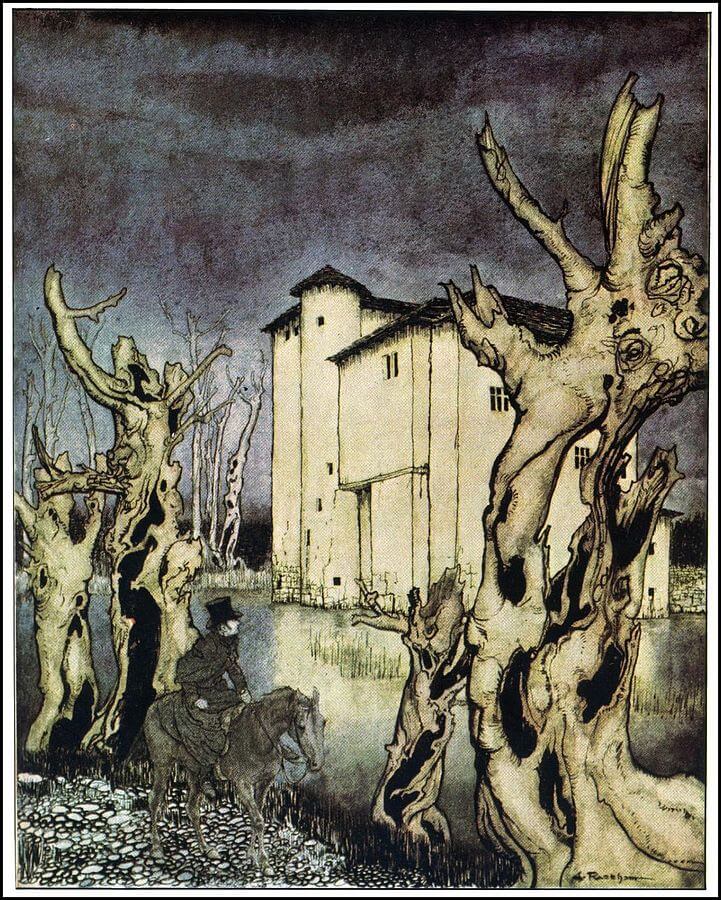
In “The Fall of the House of Usher,” the setting, diction, and imagery combine to create an overall atmosphere of gloom. The story opens on a “dull, dark, and soundless day” in a “singularly dreary tract of country.” As the narrator notes, it is autumn, the time of year when life begins to give way to old age and death. A mere glimpse of the Usher mansion inspires in the narrator “an iciness, a sinking, a sickening of the heart.” Upon entering the house, the reader as the narrator navigates through a series of dark passages lined with carvings, tapestries, and armorial trophies. Poe draws heavily on Gothic conventions, using omens and portents, heavy storms, hidden passageways, and shadows to set the reader on edge. Just like in the episode, Poe's short story of the same name features a party thrown by a character called Prospero (played in the series by Sauriyan Sapkota) which is crashed by a mysterious masked figure. Instead of contending with acid falling through overhead sprinklers, the politically influential revellers in Poe's story are the aristocracy trying to escape a plague within the privileged confines of the prince's palace — but in the end, it comes for them all.
Until his death, he believed that the New England literary establishment had stolen his glory and had prevented the Stylus from being published. Summoned to the House of Usher by a “wildly importunate letter,” which “gaveevidence of nervous agitation,” the first-person narrator goes to reside for atime with the writer of this letter, Roderick Usher. Although Roderick had beenone of his “boon companions in boyhood,” the narrator confesses early in thestory that “I really knew little of my friend”; yet, by the end of this gothictale, he has learned more about the occupants of the House of Usher than he isequipped to deal with. A week after Madeline’s death, the narrator lies awake with an unexplainedfeeling of fear. A storm rages outside, and despite efforts to reason withhimself, he shakes with terror.


No comments:
Post a Comment